Friday, September 4, 2009

Squadron Leader Shabbir Alam Siddiqui Shaheed


A PAF Bomber pilot stationed at PAF Base Mauripur (now Masroor) in 1965 when the war broke out. 

He belonged to the No. 8 Squadron of PAF under the No. 31 Bomber Wing, which flew Martin B-57 Bombers.

Friends and the family of Sqn Ldr Alam Siddiqui relate that he was an extremely energetic and patriotic individual. 6 feet tall and a mountaineer by hobby he was the kind who keep looking or challenges. He always used to pray to be able to deliver his best for service to Pakistan whenever need arises and often used to wish to be able to offer the ultimate sacrifice for the Pakistan which he had seen gaining independence during his student days. He had seen the sacrifices and hardships that had been faced in order to gain freedom and Pakistan. And he was sure he would never think twice if he was needed to play a crucial role for Pakistan's security.

He had initially been commissioned into PAF in 1954 as a navigator, but being in love with flying he convinced the PAF Chief AM Asghar Khan to allow him to return to the PAF College Risalpur as a commissioned officer to get re-trained as a fighter pilot. He remains the first officer in PAF history to have achieved this distinction.

On 6 September 1965 he left home in the morning after being informed of the war. He and his companions waited impatiently for orders to pounce at the enemy. By noon after FM Ayub Khan's blood warming and motivating speech they received orders to strike India's Jamnagar Airfield at dusk, in order to neutralize the threat to Southern parts of Pakistan from India's air base just 258 Miles from Karachi.

6 bombers flew at dusk and delivered a surprise attack successfully and returned. Sqn Ldr Alam Siddiqui was one of the bombers in the team. After return it was decided that the bombers would continue to bomb the airfield through out the night in a bombing 'shuttle service' of sorts. Only this time each B-57 bomber would fly as a single attacker.

Sqn Ldr Alam Siddiqui went on his second mission at about 2200 Hrs with his navigator Sqn Ldr Aslam Qureshi. They returned by midnight safely with after carrying out their duty and completing the mission.

By this time both must have been extremely tired, and Sqn Ldr Alam Siddiqui must have been highly fatigues as every aviator or anyone for that matter knows that flying repeated missions is no easy task. A single mission is extremely exhausting and demanding. Regular military training missions alone are very tough. This was a real war mission in the face of great danger after intruding into Indian air space. 
Sqn Ldr Shabbir Alam Siddiqui had just flown two repeated missions. And now he was ready and volunteering for a third mission right away after having an aircraft ready, refueled and armed for him to attack again.
This heroic Pakistan warrior of the skies was now about to fly on his 3rd mission within 9 hours. Which is not just a PAF record in war missions but even in regular training missions as well.

The B-57 Bomber with the two brave aviators, Alam Siddiqui the pilot in the front and Aslam Qureshi in the back as navigator flew off Pakistani soil at 0330 Hrs on the morning of 7 September once again. Volunteering for the dangerous mission. They felt that since they had been over the target multiple times they had better knowledge of the area than others who had not been there yet or those who had been there just once. 

By all means this was a gesture of service beyond the call of duty, in the face of grave danger and with disregard for personal well being and safety, only out of love and devotion to the motherland and the service to which they belonged. 

As they neared their target in the darkness the area was covered with low clouds as reported by pilots who had just returned from there while they were approaching. 

Suddenly the aircraft lost control and crashed in a field around Jamnagar in Gujrat state. 

For many years it was believed that either out of fatigue, or due to being spatially disroiented due to lack of visibility and bad weather, the B-57 must have hit the ground while the pilot tried to descend very low to ensure bombing precision. And for years it was thought by PAF as well as the family of Sqn Ldr MS Alam Siddiqui that he must have ejected and would have been taken POW along with his companion Sqn Ldr Aslam Qureshi.


India however never claimed shooting down the bomber or having the crew as POW. Until 2006 that is!

In 2006 Mrs Alam Siddiqui and her long hope and love for her husband inspired an old friend of her husband who was also an ex PAF pilot Sqn Ldr later Air Cdre Najeeb Ahmed Khan to write to then Indian Air Force Chief ACM S P Tyagi, for some help and details about what really happened.

Surprisingly ACM Tyagi responded enthusiastically and welcomed the wife and friend of the lost warrior to India. There they showed them records, took them to the crash site and it was confirmed that the B-57 Bomber aircraft had indeed been shot down by Indian AAA fire and the bodies were buried near crash site and acknowledged the brave actions of the pilot and honoured his wife and friend.

A sad note remains that both heroes Sqn Ldr Alam Siddiqui as well as Sqn Ldr Aslam Qureshi remained undecorated and received no medals in recognition for their selfless devotion and ultimate sacrifice for the motherland. Their families and their children have prospered and have made a good name for themselves. Alam Siddiqui's wife was 21 when he was martyred and his two sons were 13 months and 1 month old respectively. One is an airline pilot and the other a surgeon. Aslam Qurehi's wife was 23 and their kids were a 2 year old daughter and a 1 month old son, a marketing executive and a lawyer respectively.

The service beyond the call of duty and ultimate sacrifice of their fathers in laying down their lives for their beloved Pakistan they embraced eternal glory and shall forever be remembered among the brightest of stars in the hall of fame of Pakistani war heroes and makes the entire nation and ever new generation proud of our valiant war heroes.

Ahmad Nadeem Qasmi


Ahmad Nadeem Qasmi (real name, Ahmad Shah Awan November 20, 1916 – July 10, 2006) was a legendary Urdu language Pakistani poet, journalist, literary critic, dramatist and short story author.

Born in 1916 amidst the scenic Soon-Sekasar valley in district Khushab, nature influenced the evolution of Qasmi’s poetic sensibilities. Exposure to the grim realities of rural India’s inequities also played their part in his development as a writer; the underlying theme of his poetry is human dignity and his short stories - regarded as next in line to another master, Munshi Prem Chand, for their directness and simplicity - portrayed the woes of the Punjabi peasantry and their interaction with power structures. Following his matriculation from Campbellpur in 1931, around the time when he wrote his first poem, he moved to the Sadiq Egerton College in Bahawalpur and graduated in 1935.A graduate of the Punjab University, Nadeem Qasimi started his career as a government clerk, which he eventually left to pursue journalism.

With some 50 books of poetry, fiction, criticism, journalism and art to his credit, Qasmi was a major figure in contemporary Urdu literature. His poetry stood out among his contemporaries' work for its unflinching humanism, and Qasmi's Urdu afsana (short story) work is considered by some second only to Prem Chand in its masterful depiction of rural culture. He also published and edited the prestigious literary journal Funoon for almost half a century, grooming generations of new writers.

Qasmi was well-grounded in his own ethos and the call for freedom and the liberation of the masses was rooted in his own past. For him, Iqbal was a poetical and intellectual force to be benefitted from rather than to be challenged, as had been done by some of his contemporaries, and he was totally drawn into the feeling of helplessness that the Muslims experienced after the abolition of the Khilafat in Turkey. He looked up to the leaders of that movement, and his first creative outpouring was in the form of a poem for Muhammad Ali Jauhar in 1931. He was then inspired by Maulana Altaf Hussain Hali and more so by Zafar Ali Khan for their simple but rousing verses written directly for the Muslim community. It was a little later that he took to writing other forms of literature. He did eventually scatter himself in fiction, poetry, plays and journalism – all served as means to express an irrepressible nature and still had the energy for political activism. He had to pay a price of persecution for his words and actions as it also paved the way for his recognition.

He became active member of the Progressive Writers Movement, for a time holding the position of secretary, and was consequently arrested many times during the 1950s through the 1970s.

In his long career as a writer and editor, Qasmi Sahib had the distinction of editing several prominent literary journals, including Phool, Tehzeeb-i-Niswaan, Adab-i-Lateef, Savera, Naqoosh, and his own brainchild, Funoon. He also served as the editor of the prestigious (now defunct) Urdu daily Imroze. For several decades Qasimi contributed weekly columns to national newspapers; a classic example was "Rawan Dawan" in the daily Jang, which focused on current issues.

In 1974, he was appointed secretary-general of the Majlis-Taraqee-Adab - a Board of Advancement of Literature established by the government of West Pakistan in 1958 - and Qasmi worked in that position till his last.

Qasmi died on the 10th of July, 2006 of complications from asthma at the Punjab Institute of Cardiology in Lahore.

Achievements:

  • President’s Pride of Performance (1968)
  • Pakistan Academy of Letters’ lifetime achievement award
  • the Sitara-i-Imtiaz, (country's highest civil award)

Major publication:

Poetry books:

  • Jalal-o-Jamal,
  • Shola-i-Gul
  • Kisht-i-Wafa

Short story Books:

  • Chopaal, Sannata
  • Kapaas ka Phool
  • Bagolay
  • Tal-o-Gharoob
  • Sailab-o-Gardab
  • Anchal
  • Ghar se ghar tak..

Thursday, September 3, 2009

Nasir Kazmi


Syed Nasir Raza Kazmi, (1925-1972) was a renowned Urdu poet of Pakistan. He was one of the greatest poets of his era.

Kazmi was born on December 8, 1925 at Ambala in British India. He was educated at Ambala, Simla and Lahore. He returned to Ambala in 1945 and started looking after his ancestral land. After the creation of Pakistan in 1947, he came to Lahore. He did some journalistic work with Auraq-e-Nau as an editor and became editor-in-chief of the magazine Humayun in 1952. Later he was associated with Radio Pakistan, Lahore and other literary publications and organizations.

Nasir Kazmi started his poetic life in 1940 by following the style of Akhtar Sherani and wrote romantic poems and sonnets. Later he began writing ghazals under the guidance of Hafeez Hoshyarpuri. He was a great admirer of Mir Taqi Mir and probably the melancholy and "Ehsaas-e-Mehroomi" in his poetry was a direct result of that. His tutor in poetry was Hafeez Hoshyarpuri.

He migrated from Ambala, India to Lahore Pakistan in August 1947. He also worked as a Staff Editor in Radio Pakistan. He used to sit at Tea House and wander at Mall Rd, Lahore with his friends. He was fond of eating, wandering and enjoying life. Normally people take him as a sad poet but most of his poetry is based on romantic happiness and the aspect of hope.

Nasir, few days before his death, said in a TV interview by Intezaar Hussain, that 'horse riding, hunting, wandering in a village, walk along the river side, visiting mountains etc were my favourite pastimes and probably this was the time when my mind got nourishment for loving nature and getting close to the expression of poetry. All my hobbies are related with fine arts, like singing, poetry, hunting, chess, love of birds, love of trees etc... i started poetry because I used to reflect that all the beautiful things those I see, and those in nature are not in my hands, and they go away from me. Few moments, that time which dies, cannot be made alive. I think can be alive in poetry, that is why I(Nasir) started poetry!' Nowadays, very few people may remember that Nasir used to hum his poetic verses and that humming had much attraction in it.

His lyrics transformed the traditional pessimism of the lyric into an expression of the sorrow, despair and anguish of the modern man. His poetry expresses the tragedly of the bloodshed and migration at the time of partition of the sub-continent.

Few people know that he did some great translations of English poets, especially his translation of Walt Whitman's "Crossing Brooklyn Ferry" by the title of "Brooklyn Ghaat Ke Paar" is a real masterpiece and worth reading.

His last four books tragically were published after his death. He died in Lahore on March 2, 1972 due to stomach cancer.

Books

  * Barg-e-Nae (1952)
  * Deewaan (1972)
  * Pehli Baarish (1975)
  * Nishat-e-Khwab (Collection of nazms, 1977)
  * Sur Ki Chhaya (Manzoom Drama, Katha 1981)
  * Khushk Chashme ke Kinare (Prose, 1982 edited by Hassan Sultan Kazmi, New Edition 1990, essays, radio features, dialogues, editorials, last interview etc)
  * Nasir Kazmi Ki Dairy (Chand Pareshan Kaghaz) (Autobiography, 1995 compiled by Hassan Sultan Kazmi)
  * Intekhab-e-Meer (poetry 1989)
  * Intekhab-e-Nazeer (poetry 1990)
  * Intekhab-e-Wali Dakni (poetry 1991)
  * Intekhab-e-Insha (poetry 1991)
  * 'Intekhabs' of other poets

Some pieces of work

  • kuchh to ehasaas-e-ziyaaN thaa pehle
    dil ka ye haal kahaaN thaa pehle

    ab to manzil bhi hai Khud garm-e-safar
    har qadam sang-e-nishaaN thaa pehle

    safar-e-shauq ke far_sang na puuchh
    vaqt beqaid-e-makaaN thaa pehle

    ye alag baat ki Gam raas hai ab
    is men andeshaa-e-jaaN thaa pehle

    yuuN na ghabraaye huye phirte the
    dil ajab kunj-e-amaaN thaa pehle

    ab bhi tuu paas nahiin hai lekin
    is qadar duur kahaaN thaa pehle

    Dere Daale hain bagolon ne jahaaN
    us taraf chashm-e-ravaaN thaa pehle

    ab vo dariyaa na bastii na vo log
    kya Khabar kaun kahaaN thaa pehle

    har Kharaabaa ye sadaa detaa hai
    main bhi aabaad makaaN thaa pehle

    kya se kya ho ga_ii duniyaa pyaare
    tuu vahiin par hai jahaaN thaa pehle

    ham ne aabaad kiyaa mulk-e-suKhan
    kaisaa sun_saan samaaN thaa pehle

    ham ne baKhshi hai Khamoshii ko zubaaN
    dard majabuur-e-fuGaaN thaa pehle

    ham ne roshan kiya maamuur-e-Gam
    varna har simt dhuaaN thaa pehle

    Gam ne phir dil ko jagaayaa 'Nasir'
    Khaanaa_barbaad kahaaN thaa pehle

    *************************************************
  • safar-e-manzil-e-shab yaad nahiiN
    log ruKhsat hue kab, yaad nahiiN

    vo sitaara thii ki shabnam ki phuul
    ek suurat thii ajab yaad nahiiN

    aisaa uljhaa Gham-e-duniaa meN
    ek bhii Khwaab-e-tarab yaad nahiiN

    kaisii viiraaN hai guzargaah-e-Khayaal
    jab se voh aariz-o-lab yaad nahiiN

    yeh haqiiqat hai ki ahbaab ko ham
    yaad hii kab the jo ab yaad nahiiN

    yaad hai sair-e-chiraaGaaN 'Nasir'
    dil ke bujhne ka sabab yaad nahiiN


Wednesday, September 2, 2009

Faiz Ahmed Faiz


He was a Pakistani poet considered to be one of the most famous modern Urdu poets.

Date of Birth: February 13th, 1911
Place: Sialkot (Punjab), Pakistan

Faiz's mother was Sultan Fatima. Faiz's father died in Sialkot in 1913. Faiz's father was a learned man and enjoyed the company of well-known literary persons. Wrote the biography of Amir Abdur Rehman. Faiz was therefore, born in a respectable and literary environment and was a very promising student with a religious background.


Primary Education:

Started memorizing the Holy Quran at the age of four and in 1916 started his formal education in the famous school of Moulvi Ibrahim Sialkoti, and learnt Urdu, Persian and Arabic. Was admitted to the Scotch Mission High School in 1921 in Class IV. Passed his Matriculation Examination in the 1st Division from Murray College, Sialkot and during this period learnt Persian and Arabic from Allama Iqbal's teacher, Shamsul Ullama Moulvi Syed Meer Hasan.


College Education: Passed his B.A. (Honours) in Arabic from the Government College, Lahore and then M.A. in English from the same College in 1932. Passed his M.A. in Arabic in the 1st Division, from Oriental College, Lahore.

Employment:

Lecturer in English at M. A. O. College, Amritsar in 1935 and then at Hailey College of Commerce, Lahore. Joined the Army as Captain in 1942 and worked in the department of Public Relations in Delhi. Was promoted to the rank of Major in 1943, and Lieut. Colonel in 1944. Resigned from The Army in 1947 and returned to Lahore, where, in 1959 appointed as Secretary, Pakistan Arts Council and worked in that capacity till 1962.

Returning from London in 1964 he settled down in Karachi and was appointed as Principal, Abdullah Haroon College , Karachi. Editorship of the monthly magazine Adabe-Latif from 1947 to 1958. Worked as Editor under the Progressive Papers Ltd, of the Pakistan Times, the Urdu newspaper Imroze and the weekly Lailo-Nihar. In the 1965 war between India & Pakistan he worked in an honorary capacity in the Department of Information. Acted as Editor of the magazine Lotus in Moscow, London and Beirut.Faiz wrote poems that opposed the bloodshed occurring in what became Bangladesh during the conflict with Pakistan.

Political Affialations

In a certain period of his life, Faiz was a communist and was associated with the Communist Party of Pakistan. Faiz spent much of the 1950s and 1960s promoting the cause of communism in Pakistan. During the time when Faiz was editor of The Pakistan Times, one of the leading newspapers of 50s, he lent editorial support to CP. He was also involved in the circle lending support to military personnel (e.g. Major General Akbar Khan. This involvement with CP and Major General Akbar Khan's coup plan lead to his imprisonment later.

Imprisonment


Faiz was charged with complicity in a failed coup attempt known as the Rawalpindi Conspiracy Case and was sentenced to four years' imprisonment in 1951. The jail term gave him a first-hand experience of the harsh realities of life, and provided him with the much-needed solitude to think and write poetry. Two of his greatest works Dast-e-Saba and Zindan-Nama were products of this period of imprisonment.

Publications

Naqsh-e-Faryadi, 1941
Dast-e-Saba, 1953
Zindan Nama, 1956
Mizan, a collection of literary articles, 1956
Dast Tah-e-Sang, 1965
Sar-e-Wadi-e-Seena, 1971
Sham-e-Shehr-e-Yaran, 1979
Merey Dil Merey Musafar, 1981
Nuskha-Hai-Wafa, 1984 (A collective work)
Pakistani Culture, (Urdu and English)

Achievements:

Faiz was the first Asian poet to be awarded the Lenin Peace Prize, the Soviet Union's equivalent to the Nobel Prize in 1963.

Other notable recipients include Pablo Neruda, Nelson Mandela, W. E. B. Du Bois, Bertolt Brecht, Fidel Castro and Nobel Prize winning Chemist Linus Pauling.

The real award for a poet is the love and appreciation of his fans and Faiz enjoyed both for most of his life.

He recorded for the Library of Congress in 1977 which has fifty two works by him.


Before his death in 1984 he was also nominated for the Nobel Prize.

Death:

He was died in 1984.

Some MasterPieces:

Donon jahaan teri mohabbat mein haar ke
Woh jaa raha hai koi shab-e-gham guzaar ke

Viraan hai maikada khum-o-saaghar udaas hain
Tum kya gaye ke ruth gaye din bahaar ke

Ek fursat-e-gunah mili woh bhi chaar din
Dekhe hain hum ne hausle parwardigaar ke

Duniya ne teri yaad se begaana kar diya
Tujh se bhi dilfreb hain gham rozgaar ke

Bhule se muskra ke diye woh aaj Faiz
Mat puchh walwale dil-e-nakarda kaar ke

***************************************************

Hum parwarash-e-loh-o-qalam karte rahenge
Jo dil pe guzarti hai raqam karte rahenge

Asbaab-e-gham-e-ishq baham karte rahenge
Viraani-e-dauraan pe karam karte rahenge

Haan talkhi-e-ayyaam abhi aur barhe gi
Haan ahl-e-sitam mashq-e-sitam karte rahenge

Manzur yeh talkhi yeh sitam hum ko gawaara
Dam hai to madaawa-e-alam karte rahenge

Maikhana salaamat hai to hum surkhi-e-mai se
Tazzain-e-dar-o-baam-e-haram karte rahenge

Baqi hai lahu dil mein to har ashk se paida
Rang-e-lab-o-rukhsar-e-sanam karte rahenge

Ek tarz-e-taghaaful hai so woh unko mubaarak
Ek arz-e-tamanna hai so hum karte rahenge

********************************************************

Du'aa (Prayer) -- A nazm for Pakistan's Independence Day, 1967

aayeh hath uthein hum bhi
hum jinhein rusm-e du'aa yaad nahin
hum jinhein soz-e muhabat ke siwa
koi buth, koi khuda yaad nahin

aayeh urz guzarein keh nigar-e hustee
zehar-e imroz mein shirenya furda bhar de
wo jinhein taab-e garaan bary-a iyaam nahin
un ki pulkoon peh shaub-e roz ko hulka ker de

jin ki aankhoon ko roz-e subh ka yaara bhi nahin
un ki raatoon mein koi shuma munawar ker de
jin ke kadumoon ko kisi reh ka sahara bhi nahin
un nazroon peh koi raah ujagar ker de

jin ka deeN pariw-e kizb-o riya hai un ko
himet-e kufr mile, jurat-e tehqiq mile
jin ke sir muntazar-e tegh-e jafa hein un ko
dust-e qatil ko jatuk deenay ki taufiq mile

ishq ka sir-e nihaaN jaan tapaaN hai jis se
aaj iqrar karein aur tapish mit jaa'e
hurf-e haq dil mein khatakta hai jo kante ki turhaaN 
aaj izhar karein aur khalish mit jaa'e

Hanif Muhammad


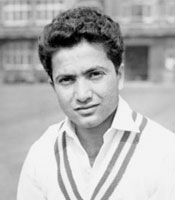
Hanif Mohammad was born 21 December 1934 in Junagadh - now in Gujarat, India is a former Pakistan cricketer.

He played for the Pakistani cricket team in 55 Test matches between 1952/53 and 1969/70 and averaged 43.98, with twelve hundreds. The highest of those centuries, 337 against West Indies in 1957/58, was the longest innings in Test history (and stood as the longest in all first-class cricket for over 40 years) as Hanif spent more than 16 hours at the crease. It is the only test match instance of a triple century in a team's second innings. Displays such as this earned him the nickname "Little Master".


In 1958/59, he surpassed Don Bradman's record for the highest individual first-class innings. Hanif made 499 before being run out attempting his five hundredth run; this mark stood for more than 35 years before being eclipsed by Brian Lara in 1994. In all he made 55 first-class centuries and finished with a strong first-class career average of 52.32. He could bowl with either arm, and kept wicket on a number of occasions.

Hanif's career lasted until 1975/76, but he never played in the English County Championship, although he did have a single outing for the Northamptonshire Second XI in August 1965 whilst preparing for his appearance for a Rest of the World XI against England at the Scarborough Festival a few days later. Hanif was named as a Wisden Cricketer of the Year in 1968. In January 2009, Hanif was named along with two other Pakistani players, Imran Khan and Javed Miandad among the inaugural batch of 55 inductees into the ICC's Hall of Fame.

In a Test match against Australia, Hanif scored a century in the first innings. In the second innings he was wrongly given stumped out by Barry Jarman off the bowling of Tom Veivers for 93, just 7 runs shy of his second century in the Test. Hanif respected the umpire's decision. Later in a press conference Jarman admitted that Hanif was not out.

Abdul Hafeez Kardar


Abdul Hafeez Kardar or Abdul Kardar was born Lahore, 17 January 1925, died 21 April 1996) was an international cricketer for both India and Pakistan. He became the first captain of Pakistan, and is widely regarded as Pakistan cricket's father figure.
He was educated at Islamia College Lahore. Kardar was a domestic cricket for teams like Oxford University, Northern India and Muslims, under the name Abdul Hafeez. He was one of the few players of that generation who played for India in Tests against England, and following the independence representing Pakistan. Kardar was appointed to lead the team which would play its first official Test, and series touring India in 1952-1953. Kardar fielded his men against Lala Amarnath's Indian team. Although India won in Delhi and Bombay and won the series, Kardar's Pakistan achieved their first Test victory in only their second Test in Luckhnow.
He was a left-handed batsman and a slow left-arm orthodox spin bowler, scoring 6,832 runs and taking 344 wickets in first class cricket. He averaged 29.83 in batting, and 24.55 in bowling.
Kardar captained Pakistan against all the Test playing nations of the day, and achieved an unparalleled distinction of leading his team to victories against each of them, which for a nascent cricketing nation was unheard of. Especially famous was the series-leveling victory achieved touring England in 1954 at The Oval. It was unimaginable for the cricket's godfather nation and team to be beaten by minnows in their first rubber, in England.
Kardar and his men also created history by winning the first-ever and only Test against Australia in Karachi in 1957.
Kardar's Pakistan, although aggressive, motivated and confident, was still immature, inexperienced and raw in their cricketing skills to win series victories. The attitude of the players was especially criticized when all the 5 Tests played by the Indian cricket team on its first tour of Pakistan in 1954-1955, were drawn. The fear of both Indian and Pakistani players of losing to each other, owing to political tensions and the bloody legacy of independence was too much for competitive cricket to be played. In Kardar's tenure, Pakistan won 6, lost 6 and drew 11 matches in 23 Tests. Kardar retired in 1958.
Kardar had been a strong supporter of Mohammad Ali Jinnah and an adherent to the idea of Muslim glory in India.
Abdul Hafeez Kardar went into politics and served as the president of the Pakistan Cricket Board in the 1970s. His tenure was notable for increasing representation of Asian and African cricketing nations with the International Cricket Council. Kardar was forced to resign after an embarrassing pay dispute with the players in 1977.
Kardar served with many charitable and social development causes, and in the last years of his life served as Pakistan's ambassador to Switzerland. He died in his hometown, Lahore in 1996.
Kardar is today credited with popularizing the game with common Pakistani people and youth, for his tutelage of some of Pakistan's greatest cricketers, young talent and prodigies, and his stewardship of the Pakistan team and the board in its early years, developing a culture of pride and professionalism.